
Buying a Car in Indonesia: A Comprehensive Guide 2025
Visa code update: The Retirement KITAS, formerly index C319, is now E33F (1 year, applicants aged 55 and over, sponsor required) or E33E (5 years, USD 50,000 deposit, no sponsor). See the E33F and E33E pages.
Buying a car in Indonesia as an expat can be a complex decision. This guide will equip you with the essential factors to consider, empowering you to make an informed choice that aligns with your needs and circumstances.
How Much Does A Car Cost in Indonesia?
New cars offer the latest features, technology, and warranty coverage, but come at a premium. Used cars can be a significant cost saver, but require thorough inspection and research to ensure they’re in good condition and have a clean history.
Consider how long you plan to stay in Indonesia. If it’s for a shorter period, a used car with good resale value might be a better option. Additionally, factor in maintenance costs.
Newer cars might have lower maintenance needs in the short term, but as they age, repairs can become expensive. Compare the total cost of ownership for both new and used cars to make an informed decision.
The cost of a car in Indonesia can vary significantly based on factors such as make, model, and condition (new vs. used). Here is a comprehensive overview based on recent data and sources.
Average New Car Prices
The average price of new cars in Indonesia has shown a significant upward trend. As of 2023, the average new car price has risen to approximately IDR 347 million (about USD 23,200), compared to around IDR 193 million in 2011. This increase can be attributed to several factors, including inflation and adjustments in taxes or import regulations.
The Used Car Market
The used car market in Indonesia is highly active, and vehicles tend to retain excellent resale value. Due to consistent demand, the prices of used cars often remain close to their initial purchase costs. For example, a well-maintained 2011 Chevrolet Captiva diesel might cost around IDR 170 million (approximately USD 11,200) even after years of depreciation. This strong retention in resale value makes the used car market a fine alternative for many buyers.
Most Popular Brands 2023
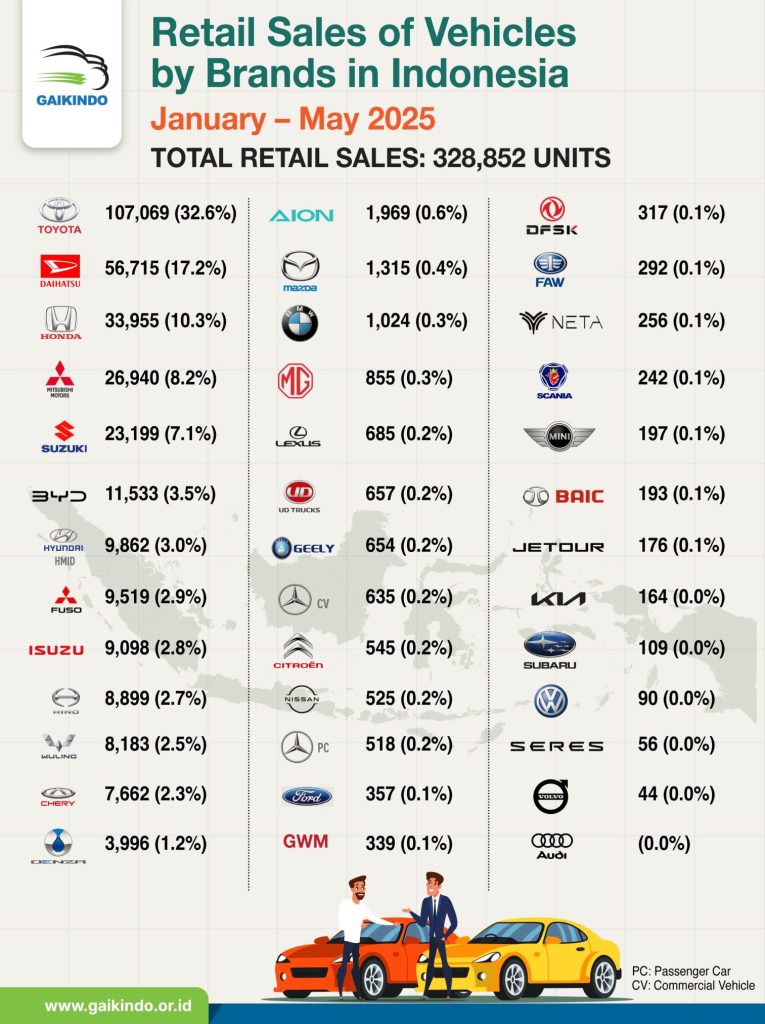
In 2023, the automotive market in Indonesia is largely dominated by Japanese car manufacturers, which have consistently delivered vehicles that cater to diverse preferences and budgets. Below is a detailed breakdown of the top 10 car brands based on sales data for the year:
- Toyota: Toyota solidifies its leadership in the Indonesian market with sales reaching approximately 336,777 units in 2023. This accounts for 33.5% of the market share, making Toyota the most dominant brand. Models such as the Toyota Avanza (IDR 233-295 million) and Toyota Kijang Innova enjoy widespread popularity across different buyer demographics.
- Daihatsu: Securing the second position, Daihatsu boasts significant sales figures of around 188,000 units, capturing an 18.7% market share. The Daihatsu Sigra, in particular, stands out as a favorite model priced between IDR 140-170 million.
- Honda: With strong sales of 138,967 units and a market share of 13.8%, Honda claims the third spot. The compact and affordable Honda Brio, priced from IDR 157 million to IDR 237 million, continues to drive the brand’s success in Indonesia.
- Suzuki: Suzuki maintains a steady presence in the market, selling approximately 81,057 units in 2023, which represents 8.1% of overall sales. Popular models like the Suzuki Ertiga are priced between IDR 225-290 million.
- Mitsubishi: Mitsubishi sold a notable 77,416 units, accounting for a 7.7% market share. The Mitsubishi Xpander, priced between IDR 270-320 million, remains one of the best-selling models, particularly favored for its spacious design and reliability.
- Hyundai: Hyundai achieves a strong foothold in 2023 with a sales volume of about 35,500 units, representing 3.5% of the market. The Hyundai Stargazer is gaining attention, priced between IDR 245 million and IDR 310 million.
- Isuzu: Known for its durable and practical vehicles, Isuzu recorded sales of around 31,427 units, further solidifying its standing in the Indonesian automotive market. Models like the Isuzu Panther are commonly priced from IDR 300-350 million.
- Wuling: As an emerging player, Wuling has performed well, selling 23,540 units, which translates to a 2.3% market share. Models such as the Wuling Almaz range from IDR 285-350 million.
- Mercedes-Benz: In the luxury car segment, Mercedes-Benz sold 5,498 units in 2023. Its entry-level luxury cars, such as the Mercedes-Benz A-Class, are typically priced at IDR 600 million and above.
- BMW: Rounding out the top ten, BMW recorded sales of 4,362 units, focusing primarily on premium and luxury-oriented customers. Models like the BMW Series 3 start at around IDR 800 million.
Most Popular Brand 2025
Best-Selling Car Models in Indonesia
Among all the brands and models available in the Indonesian automotive market, several prominent best-sellers consistently resonate with consumers due to their design, affordability, and practicality.
As of 2023, the Toyota Avanza holds the title of the best-selling car in Indonesia. Known as the “people’s car,” the Toyota Avanza is highly appreciated for its spacious interior and reliable performance, making it ideal for family use, with prices ranging from IDR 233 million to IDR 295 million.
The Honda Brio follows closely, becoming the top choice for individuals and young professionals seeking a compact and efficient vehicle, with prices spanning IDR 157 million to IDR 237 million.
Lastly, the Mitsubishi Xpander, with its appealing combination of style, versatility, and competitive pricing, remains a strong contender in the multi-purpose vehicle (MPV) category, priced between IDR 270-320 million.
Buying a New Car
Requirements for Expats:
- Valid Passport and KITAS/KITAP: A valid passport is mandatory, and you must hold either a KITAS (temporary residence permit) or KITAP (permanent residence permit) to legally own a car in Indonesia.
- Letter from Sponsoring Company (if applicable): If your employer is sponsoring your car purchase, you’ll need a letter from them authorizing the purchase.
Requirements for Indonesians:
- KTP (Kartu Tanda Penduduk): Indonesian citizens need to present their national identity card (KTP) for car registration.
Financing Options:
- Cash Payment: The most straightforward option, but requires having the full purchase price readily available.
- Car Loan: Expats may face challenges securing car loans from Indonesian banks. However, some automotive finance companies affiliated with dealerships offer financing options, often requiring a down payment of at least 25% of the total cost.
- Leasing: Some joint venture finance companies offer leasing contracts for expats, particularly for vehicles from their affiliate companies. This option typically requires a letter of guarantee from your employer and a down payment.
Documents to Receive Upon Purchase:
- STNK (Surat Tanda Nomor Kendaraan): Vehicle registration document, which must be carried in the car at all times.
- License Plates (Plat Nomor): Official license plates for your vehicle.
- BPKB (Buku Pemilik Kendaraan Bermotor): Proof of ownership book; keep this document safe and avoid storing it in the car.
- Faktur (Original Invoice): Invoice for the car purchase.
- Kwitansi Pembayaran (Receipt): Receipt for the cash transaction.
Processing Time:
After purchasing a new car, it typically takes about a week to process the STNK and license plates. You can take possession of the car immediately, but remember you cannot legally drive it on the streets until you have the STNK and plates.
Buying a Used Car
Important Note: It’s illegal to import used cars into Indonesia. Be cautious of deals that seem too good to be true, as some importers may try to pass off older vehicles as new.
Common Practice
In Indonesia, it’s common for car ownership to remain under the original owner’s name even after the car is sold. This is done to avoid the costly “balik nama” (change of ownership) fee. While not encouraged, understanding this practice is crucial when buying a used car.
Requirements:
- KTP (Kartu Tanda Penduduk): Sellers usually require the buyer’s KTP. Other forms of identification like passports or KITAS might be accepted, but it depends on the seller.
- Cash or Financing: Similar to buying a new car, you’ll need either cash or a financing option to purchase a used car.
Documents to Receive Upon Purchase:
- STNK (Surat Tanda Nomor Kendaraan): Vehicle registration document.
- BPKB (Buku Pemilik Kendaraan Bermotor): Proof of ownership book.
- Faktur (Original Invoice): Original invoice from when the car was first purchased.
- Kwitansi Blangko (Blank Receipts): Three copies, with the first filled out with car details and signed by the original owner. The other two copies remain blank but signed by the original owner. These are essential for potential future resale.
- Kwitansi/Tanda Terima (Receipt): Receipt for the transaction amount.
- Photocopy of Seller’s KTP or KITAS: Needed for renewing the yearly STNK.
Needs and Lifestyle
Before investing in a car, consider your needs and lifestyle in Indonesia. How often will you use the car? Will it be for daily commuting, weekend getaways, or occasional errands? The type of car you choose should align with your usage patterns. Here’s a list to help you decide:
- City dwellers with frequent short trips: Consider a small, fuel-efficient hatchback or compact sedan for easy maneuverability and parking.
- Families or those who frequently travel long distances: Opt for a larger sedan or SUV with ample cargo space and passenger comfort.
- Those who prioritize off-road capability: An SUV with all-wheel drive might be suitable for venturing beyond paved roads.
- Eco-conscious drivers: Explore fuel-efficient options like hybrid or electric vehicles, if available and fit your budget.
Driving Conditions and Infrastructure
Indonesian traffic and driving conditions can be quite different from what you’re accustomed to. Before buying a car, assess your comfort level driving in such an environment. Ensure you have a valid international driving permit or an Indonesian driver’s license.
Familiarize yourself with local traffic rules and regulations. Additionally, consider the parking situation in your area.
Is parking readily available or will it be a constant challenge?
Alternatives to Car Ownership
Owning a car isn’t the only game in town when it comes to transportation in Indonesia. Here’s a breakdown of some alternatives to consider:
- Public transportation, while not as extensive as in some other countries, can be a viable option for certain commutes, especially in larger cities.
- Ride-hailing services like Grab and Gojek are incredibly popular in Indonesia and offer affordable on-demand transportation.
You might also consider renting a car occasionally for specific trips, which could be more cost-effective than full ownership, especially if your car usage will be infrequent
Car Tax System in Indonesia
When buying a car in Indonesia, understanding the tax system is crucial, especially for expats. Below is an overview of the key taxes and considerations:
1. SAMSAT: The Key Agency
What is SAMSAT?
SAMSAT (Sistem Administrasi Manunggal di bawah Satu Atap) is the government agency responsible for car registration and tax payments in Indonesia. Expats must interact with SAMSAT for all car-related tax matters.
How to Access SAMSAT Services?
- Visit local SAMSAT offices in person.
- Use online services or apps like e-SAMSAT (e.g., Sambara for West Java) for checking and paying taxes conveniently.
- Some regions allow payments through e-commerce platforms (e.g., Shopee, Tokopedia) or the SIGNAL app.
2. Types of Car Taxes
- Vehicle Registration Tax (Bea Balik Nama)
- A one-time tax paid when transferring ownership of a car.
- Typically 10% of the car’s sales price, but in Jakarta, it can be up to 20%
- Expats must provide their passport and residence visa (KITAS or KITAP) for registration.
- Annual Road Tax (Pajak Kendaraan Bermotor – PKB)
- Paid annually through SAMSAT.
- Approximately 2% of the vehicle’s assessed value (NJKB).
- For a second car in Jakarta, the tax can increase to up to 10% depending on the car’s value.
- Additional surcharges apply for vehicles with engines over 4 cylinders or weighing more than 1,500 kg (e.g., SUVs).
- Progressive Tax
- Applies to owners of multiple vehicles under the same name and address
- The tax rate increases with each additional vehicle:
Vehicle Order Percentage First 2% Second 2.5% Third 3% Up to 10% Note: Progressive tax is not applied uniformly across all regions in Indonesia.
- Value Added Tax (VAT)
- Typically 10% on car sales or transfers
- Note: The VAT rate mentioned in some sources (e.g., 2011) may be outdated. Expats should verify the current rate with local authorities or tax consultants.
- Road Insurance (Sumbangan Wajib Dana Kecelakaan Lalu Lintas Jalan)
- An annual fee of approximately Rp150,000 (as of 2011, verify current rates).
3. Import Duties for Expats
- Expats importing cars into Indonesia face a 300% custom duty on the car’s value
- Exceptions apply only to embassy and consulate staff.
- Only foreigners with valid residence visas (KITAS or KITAP) can own a car in their own name.
4. Payment Methods for Expats
- Online Payment Options:
- Use regional SAMSAT websites or apps (e.g., Sambara, Sapa Warga).
- E-commerce platforms like Shopee or Tokopedia under the “Bills” section (requires a payment code from SAMSAT).
- SIGNAL app for vehicles registered under your name or family members on the same Kartu Keluarga (family card).
- In-Person Payment:
- Visit your local SAMSAT office with required documents (e.g., ID, vehicle registration certificate – STNK, ownership certificate – BPKB).
- Note: If the car is financed, you may need a BPKB proxy letter from the financing agent
5. Special Considerations for Expats
- Eligibility: Only foreigners with valid residence visas (KITAS or KITAP) can register a car in their name
- Documentation: Ensure all documents are up-to-date, including your passport, visa, and proof of address.
- Progressive Tax: If you own multiple vehicles, be aware of the increasing tax rates for subsequent cars.
- VAT and Import Duties: These can significantly increase the cost of buying or importing a car, so plan your budget accordingly.
- Recent Changes: There have been proposals for a carbon emission-based tax system, but as of 2025, it is unclear if this has been fully implemented. Expats should check with local authorities or tax consultants for the latest updates.
6. Tips for Expats
- Use Online Tools: Apps like e-SAMSAT or SIGNAL can simplify tax payments and reduce the need for in-person visits.
- Consult Tax Professionals: For complex situations (e.g., importing cars, owning multiple vehicles), consider hiring a local tax consultant familiar with Indonesian regulations
- Stay Informed: Tax rates and regulations can change, so always verify the latest information from official sources like SAMSAT or the Directorate General of Taxes.
- Plan Ahead: Ensure your residence visa is valid before registering a car, as it is a requirement.
Note: While the information provided is based on reliable sources, tax regulations in Indonesia can vary by region and may change over time. Expats are advised to consult local SAMSAT offices, tax consultants, or the Directorate General of Taxes for the most up-to-date and region-specific details.
Long-Term Plans
Your long-term plans in Indonesia should factor into your decision. If you intend to stay for a short period, buying a car might not be the most practical choice.
Consider the ease of selling the car when you eventually leave the country. If selling seems like a hassle, alternative transportation methods might be more suitable.
Buying a car as an expat in Indonesia requires careful consideration of various factors. Evaluate your budget, needs, driving conditions, legal requirements, and long-term plans, you can make an informed decision that best suits your lifestyle and financial situation.
Remember, car ownership is a significant investment, and exploring alternative transportation options is always wise before taking the plunge
Related Reading
- Indonesian Vehicle Docs Guide for Foreigners | BPKB STNK
- The Best Ride-Hailing and Taxi Apps in Indonesia
- Changing from a Retirement KITAS to a Spouse KITAS in Bali: A Complete Guide

- Global Citizen Indonesia: Policy, Benefits, Eligibility, Application, and Cost - August 27, 2026
- Indonesia Visa Free Countries List & Entry Rules 2026 - August 18, 2026
- Indonesia Digital Nomad Visa (E33G) Guide 2026 - August 17, 2026
