
Indonesia Digital Nomad Visa (E33G) Guide 2026
Visa code update: Indonesia has replaced several older visa index codes. This article still uses the previous names, mapped below to the classification currently in force.
- The B211A single-entry visit visa is no longer issued under that index. Single-entry visit visas are now classified as C1 for tourism and family visits, or C2 for business meetings, negotiations, and goods inspection.
- The Working KITAS, formerly index C312, is now E23: a limited stay visa for 180 days, 1 year, or 2 years, with an employer sponsor and a Ministry of Manpower work permit. See the E23 work visa.
- The Investor KITAS, formerly indexes C313 and C314, is now classified under E28. See the investor visa page.
- The Retirement KITAS, formerly index C319, is now E33F (1 year, applicants aged 55 and over, sponsor required) or E33E (5 years, USD 50,000 deposit, no sponsor). See the E33F and E33E pages.
The E33G Remote Worker KITAS is Indonesia’s official digital nomad visa, launched in April 2024. It grants a 1-year stay permit for foreign nationals who work remotely for overseas employers. You need a minimum annual income of USD 60,000 and a valid work contract with a non-Indonesian company. You also need health insurance and a passport with at least 18 months remaining. The government fee is IDR 7,000,000 (about USD 450). No local sponsor is required. Applications go through evisa.imigrasi.go.id. The permit is not renewable in-country: you must exit and reapply. Tax rules depend on your length of stay and whether a Double Taxation Agreement applies.
Indonesia launched the Indonesia Digital Nomad Visa alias E33G Remote Worker KITAS in April 2024 so digital nomads have a legal way to stay long-term. The permit allows foreign nationals to live in Indonesia for up to one year while working remotely for employers based outside the country. No local sponsor is needed. No Indonesian entity is involved.
Many existing guides on the Indonesia digital nomad visa are outdated. They confuse the E33G with B211A visit visas, or gloss over the tax residency questions that catch remote workers off guard. Some still claim the visa is “tax-free,” which is overly simple for a nuanced area of Indonesian tax law.
This guide covers the 2026 E33G qualifying criteria, required documents, and total cost. It also walks through the application process, tax rules, family sponsorship, and permit expiry. Every fee and rule referenced here is based on the current legal framework as of 2026, with official sources linked throughout.
Last updated: August 2026
How Digital Nomad Visa Differs From a B211A Visit Visa?
The E33G visa is a Limited Stay Permit (KITAS) created under Indonesia’s 2024 visa reform. It is designed for foreign remote workers who work for companies based outside Indonesia. The “E33” series covers non-work-based limited stays, and the “G” suffix marks the remote worker subcategory.
This is not a tourist visa. It is a formal residence permit in Indonesia’s national immigration system.
Holders get a KITAS card and can open a local bank account, sign a long-term lease, and enter and exit Indonesia with a MERP (Multiple Exit Re-Entry Permit).
The B211A is a single-entry visit visa that allows stays of 60 to 180 days for tourism, social visits, or pre-investment business. It does not permit making money activities of any kind.
Digital nomads previously used the B211A as a workaround. They relied on visa runs to extend their stay. The E33G replaced that workaround with a legal framework that clearly permits remote work for overseas employers.
Here’s the key differences:
- E33G: 1-year KITAS (residence permit), remote work allowed, multiple entry with MERP, can open bank account and sign long-term lease
- B211A: 60 to 180-day visit visa, no work permitted, single entry (extendable), limited practical rights
The E33G is issued under Indonesia’s Immigration Law (UU No. 6 of 2011) as updated by the 2024 visa category reform. The permit type and its rules are published on the official e-Visa portal at evisa.imigrasi.go.id under the Ministry of Immigration and Corrections (Kemenimipas).
Digital Nomad Visa (E33G): Requirements and Eligibility
The E33G has clear qualifying criteria. Applicants must show stable income from foreign sources and a formal work link with an overseas company.
The E33G is available to foreign nationals (WNA) who:
- Are employed by a company based outside Indonesia
- Earn at least USD 60,000 per year (about USD 5,000 per month)
- Perform their work remotely from Indonesia
- Have no work relationship with any Indonesian entity
Freelancers face a grey area. The permit language references “employment contracts,” which creates a grey zone for self-employed applicants.
Some visa consultants report successful cases from freelancers with steady foreign-client income through signed contracts.
The rule text does not cover this group directly. If you are self-employed, consult a visa specialist before applying.
Document Checklist
| Document | Detail | Notes |
|---|---|---|
| Passport | Minimum 18 months validity (for KITAS stage) | Original plus scanned copy |
| Employment contract | Signed with overseas employer | Must show annual salary of at least USD 60,000 |
| Bank statements | Last 3 months, minimum balance USD 2,000 | Shows financial stability |
| Health insurance | Coverage valid in Indonesia | Global plans accepted |
| Passport-size photo | White background | Recent, within 6 months |
| Criminal record check | SKCK equivalent or police clearance from home country | Required for some nationalities |
All documents must be uploaded online through the evisa.imigrasi.go.id portal.
Documents in languages other than English or Indonesian should be translated by a professional indonesia sworn translator.
How to Apply for the Digital Nomad Visa
The E33G application goes through Indonesia’s official e-Visa system. Many applicants use visa agents to handle document prep and follow-up.
Step-by-Step Application Process
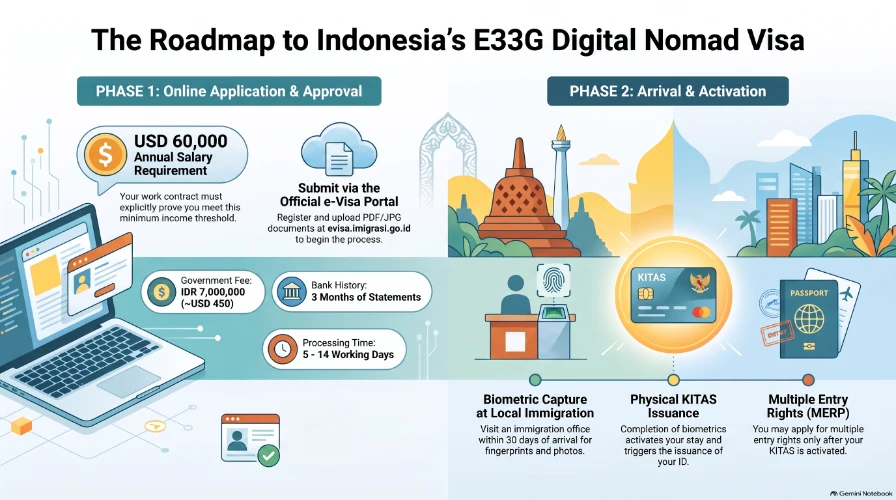
- Prepare your documents. Gather your work contract, bank statements (3 months), health insurance proof, passport scan, and passport-size photo. Make sure your contract clearly states your annual salary meets the USD 60,000 threshold.
- Create an account on evisa.imigrasi.go.id. Register with your email and passport details. The portal will guide you through visa type selection. Choose the E33G Remote Worker KITAS.
- Upload all required documents. Each document must be in PDF or JPG format, under the file size limits set on the portal. Incomplete uploads are the most common cause of delays.
- Pay the government fee. The fee of IDR 7,000,000 (about USD 450) is paid through the SIMPONI payment system. This is built into the e-Visa portal. Payment can be made via bank transfer or credit card. The fee is non-refundable.
- Wait for processing. Standard processing takes 5 to 14 working days after document submission. Some nationalities may face longer processing times if extra checks are required.
- Receive your e-Visa. Once approved, you will receive a PDF e-Visa by email. This document must be shown upon arrival in Indonesia. You have 90 days from the issue date to enter Indonesia. If you do not enter within this window, the visa expires with no refund.
- Arrive and register at local immigration. Within 30 days of arrival, visit the local immigration office to complete biometric capture (fingerprints and photograph). This step activates your KITAS.
- After biometric sign-up, you will receive your physical KITAS card and be entered in the immigration system. You can then apply for a MERP if you need multiple entry rights.
For a detailed walkthrough of the online visa application system, see our guide on how to apply for an Indonesia visa online.
Cost and Fees
The E33G involves several layers of cost. Understanding the breakdown helps applicants budget accurately.
Government Fees
The primary government fee for the E33G visa is IDR 7,000,000 (about USD 450), paid through the SIMPONI system. This covers the visa and KITAS permit.
If you need a Multiple Exit Re-Entry Permit (MERP), the fee is about IDR 1,500,000 (USD 85 to 95). Without a MERP, leaving Indonesia will void your KITAS.
Agency Fees
Visa agencies like BaliPAS charge added service fees for document prep, form submission, follow-up with immigration, and in-person help at the immigration office. Agency fees vary based on the level of service and speed. Total cost including agency fees usually ranges from USD 850 to USD 1,200.
Onshore vs Offshore Application
Applying from outside Indonesia (offshore) is the standard route. If you are already in Indonesia on a valid visit visa (such as C1), you can apply for the E33G through the onshore “alih status” (status change) process. Onshore processing costs more (about IDR 15,000,000). It also takes longer (up to 30 days). During processing, you cannot leave Indonesia.
Disclaimer: All fees are subject to change. Verify current rates at evisa.imigrasi.go.id before submitting your application.
Tax Obligations for Digital Nomads in Indonesia
Tax is the area where most E33G guides are misleading. The common claim that “digital nomads pay no tax in Indonesia” is overly simple and can lead to serious legal problems.
The 183-Day Rule
Under Article 2 of Indonesia’s Income Tax Law (UU PPh No. 36 of 2008), a foreign national becomes an Indonesian tax resident if they are present in Indonesia for more than 183 days within any 12-month period. Tax residents are taxed on worldwide income at progressive rates from 5% to 35%.
If you stay fewer than 183 days and do not show intent to stay, you are normally treated as a non-resident taxpayer. Non-residents are taxed only on Indonesian-sourced income, which for an E33G holder should be zero.
The KITAS Complication
Holding a KITAS signals intent to live in Indonesia. Some tax officials see this as triggering tax residency from Day 1, regardless of the 183-day threshold.
A 2025 rule (PER-23/PJ/2025) tightened this further. It applies substance-based reviews of where your economic life is centered. Immigration data is now synced with the tax office through the One-Data System.
In practice, E33G holders who stay in Indonesia for most of the year should assume they will be classified as tax residents. Plan accordingly.
Double Taxation Agreements (DTA)
The rules are clear on one point: Indonesia has DTAs with over 70 countries. If your home country has a DTA with Indonesia, you may be able to claim relief from double taxation. This usually means you pay tax in your home country and get a credit for any Indonesian tax owed, or vice versa. The exact mechanism depends on the treaty terms with your country.
The Four-Year Foreign Income Exemption
Some guides reference a four-year tax exemption for foreign experts under PMK 18/PMK.03/2021. This exemption applies to foreigners working for Indonesian entities in certain expert roles. It does not automatically apply to E33G holders working for overseas companies. Do not rely on this exemption without consulting a tax advisor.
Practical Tax Guidance for E33G Holders
- Under 183 days, short stay: Likely non-resident. No Indonesian tax on foreign income. No NPWP (tax ID) needed.
- Over 183 days, full year: Likely tax resident. Register for NPWP. Foreign income may be taxable. Check DTA with your home country.
- KITAS holders, any duration: Tax officials may assess your stay based on intent. Keep records of your stay dates and income sources.
Disclaimer: Tax info in this guide is general in nature. Tax rules are complex and open to review. Consult a qualified tax advisor for advice specific to your situation. For a deeper look at expat tax rules, see our guide on tax rules for foreigners in Indonesia.
What Happens When the E33G Visa Expires?
The E33G is issued for a single period of up to one year. It is not renewable in-country.
The Exit-and-Reapply Process
When your E33G visa approaches expiry, you cannot simply extend it at the immigration office. Instead, you must:
- Apply for an Exit Permit Only (EPO) at your local immigration office. The fee is about IDR 100,000. Processing takes 3 to 4 business days.
- Leave Indonesia within 7 days of EPO approval.
- Submit a new E33G application from overseas, with fresh documents confirming your continued work and income.
- Wait for processing (usually 2 to 4 weeks).
- Enter Indonesia within 90 days of the new visa approval and complete biometric registration again.
This cycle repeats annually. There is no limit on how many times you can reapply, but each application is treated as a new permit from scratch.
Converting to Other Visa Types
The E33G cannot be converted to a Working KITAS (E23) without a new employer sponsor and RPTKA (Expatriate Placement Plan) approval.
If you get work with an Indonesian company, your employer must get RPTKA and IMTA (Work Permit for Foreign Workers) approval before you switch visa types.
After holding a KITAS for multiple straight years (usually 5), you may be able to apply for a KITAP (permanent stay permit).
The KITAP pathway depends on your visa type and steady stay history.
For more on the KITAS to KITAP transition, see our guide on KITAS vs KITAP stay permits.
E33G vs Other Indonesia Visa Options
Choosing the right visa depends on your income source, intended length of stay, and whether you need to work legally during your time in Indonesia.
E33G vs B211A Visit Visa
The B211A is a visit visa valid for 60 to 180 days. It does not permit any form of work. The E33G is a 1-year stay permit that clearly allows remote work for overseas employers. If you are testing whether Indonesia is a good fit before committing, the B211A is a reasonable starting point. If you plan to stay and work for a year or more, the E33G is the correct choice. For more on visit visa options, see our guide on remote work visa options in Indonesia.
E33G vs Retirement KITAS (E33F)
The E33F Retirement KITAS is open to foreign nationals aged 55 and above who meet certain financial criteria. The E33G has no age limit. If you are under 55 and working remotely, the E33G applies. If you are retired and over 55, the E33F may offer a simpler pathway. For details, see our guide on retirement KITAS financial proof.
E33G vs Investor KITAS (E28A)
The E28A Investor KITAS requires a PT PMA (foreign-owned company) with a minimum paid-up capital. The E33G requires no investment, only proof of overseas work income. If you plan to start a business in Indonesia, the Investor KITAS is the right route. If you are an employee working remotely, the E33G fits. For structural differences between these permits, see our guide on investor KITAS vs work KITAS.
E33G vs Second Home Visa
The Second Home Visa grants a 5 to 10-year stay permit for people who can deposit about IDR 2,000,000,000 (USD 130,000) in an Indonesian state bank. The E33G requires no deposit. It caps the stay at one year. The Second Home Visa suits high-net-worth people seeking a long-term stay without work. The E33G is designed for active remote workers. For details on Second Home Visa limits, see our guide on working on a Second Home Visa.
Frequently Asked Questions
Can I work for an Indonesian company on the E33G visa?
No. The E33G is specifically for remote workers employed by overseas companies. Working for an Indonesian entity requires a Working KITAS (E23) with RPTKA and IMTA approval. Using an E33G to perform work for an Indonesian employer violates the permit terms and can result in deportation and blacklisting.
How long can I stay in Indonesia with the digital nomad visa?
The E33G KITAS is valid for one year. You can enter and exit Indonesia multiple times during this period if you have a MERP (Multiple Exit Re-Entry Permit). Without a MERP, leaving Indonesia voids your KITAS. The permit is not renewable in-country. To continue staying in Indonesia, you must exit, reapply from overseas, and re-enter on a new E33G.
Do I need to pay Indonesian taxes on my remote income?
It depends on your length of stay and tax residency status. If you stay fewer than 183 days in a 12-month period, you are normally treated as a non-resident taxpayer. You owe no Indonesian tax on foreign-sourced income. If you stay longer than 183 days, you become a tax resident and may owe tax on worldwide income. However, holding a KITAS may trigger tax residency earlier, and Double Taxation Agreements with your home country may provide relief. Consult a tax advisor for your specific situation.
Can I bring my family on the E33G visa?
Yes. Spouses and unmarried children under 18 can apply for a dependent KITAS linked to your E33G. The dependent permit is valid for the same duration as your primary visa. Each family member must submit a separate application with passport, marriage or birth certificate, and proof of relationship.
What is the minimum income requirement for the digital nomad visa?
The minimum annual income threshold is USD 60,000, or about USD 5,000 per month. You must prove this through a work contract and bank statements showing consistent income at or above this level. The income must come from a foreign employer, not an Indonesian source.
Can I apply for the E33G while already in Indonesia?
Yes, but only if you hold a valid C1 visit visa. You can apply for a status change (alih status) from C1 to E33G through the onshore process. This costs more (about IDR 15,000,000) and takes longer (up to 30 days). You cannot leave Indonesia during processing. If you entered on a B211A, you must first convert to a bridging visa before applying for the E33G.
Is the E33G visa available for all nationalities?
The E33G is available to most nationalities. However, some countries may face additional screening or limits. Check if you qualify at evisa.imigrasi.go.id before applying. Nationals of countries on Indonesia’s restricted list may need to apply through an embassy or consulate.
How long does the E33G application process take?
Standard processing takes 5 to 14 working days after complete document submission. Processing times vary by nationality, application volume, and whether extra checks are needed. Expedited processing may be available through visa agencies for an added fee.
Closing Notes
The E33G Remote Worker KITAS is Indonesia’s first visa category written for digital nomads. It provides a clear legal framework for remote workers who want to live in Bali or elsewhere in Indonesia for up to a year. The rules are clear: USD 60,000 in annual foreign income, a formal work contract, health insurance, and a clean background.
The permit is not without issues. The annual exit-and-reapply cycle disrupts long-term planning. Tax resident rules are nuanced. The link between KITAS status and the 183-day threshold creates genuine uncertainty. Freelance qualification remains a grey area in the rule text.
For remote workers who meet the income threshold, the E33G is currently the only visa that legally permits long-term remote work from Indonesia. A stable overseas work contract is the key requirement. The alternative is operating on visit visas, which carries legal risk and offers none of the practical benefits of a residence permit (bank accounts, long-term leases, multiple entry).
About the author: Hariyono Suwardi is a visa specialist with over 15 years of experience in Indonesian immigration law and practice. He has helped hundreds of foreigners with visa applications, extensions, and legal matters.
Disclaimer: BaliPAS is a private visa consultancy and is not part of the Directorate General of Immigration or any government body. Visa rules, fees, and processing times are subject to change. Always check current details at evisa.imigrasi.go.id before applying.
Related Reading
- Can a Foreign Spouse Work Legally in Indonesia? (2026 Guide)
- https://indonesiavisas.id/visa/e33f-1-year-retiree-visa
- https://indonesiavisas.id/visa/e33e-5-year-retiree-visa

- Global Citizen Indonesia: Policy, Benefits, Eligibility, Application, and Cost - August 27, 2026
- Indonesia Visa Free Countries List & Entry Rules 2026 - August 18, 2026
- Indonesia Digital Nomad Visa (E33G) Guide 2026 - August 17, 2026
