
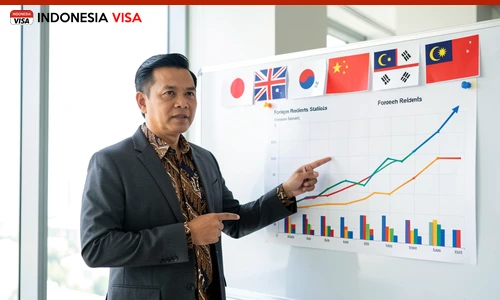
Foreign Residency Statistics in Indonesia: Trends and Implications (2026)
Visa code update: Indonesia has replaced several older visa index codes. This article still uses the previous names, mapped below to the classification currently in force.
- The Investor KITAS, formerly indexes C313 and C314, is now classified under E28. See the investor visa page.
- The Family KITAS, formerly index C317, is now E31. See the family visa page.
- The Retirement KITAS, formerly index C319, is now E33F (1 year, applicants aged 55 and over, sponsor required) or E33E (5 years, USD 50,000 deposit, no sponsor). See the E33F and E33E pages.
Indonesia’s foreign resident landscape (2026):
- 140,000+ KITAS/KITAP holders â growing rapidly (56% increase from 2021).
- Jakarta leads with 38,366 KITAS holders â more than double Bali.
- Top source countries: Malaysia (19.5%), Australia (~10%), Singapore (~9%).
Visa type breakdown:
- Work KITAS (E23) â largest category. 138,000+ permit holders.
- Investor KITAS (E28A) â growing with PT PMA setup demand.
- Remote Worker KITAS (E33G) â new category since 2024.
Compare with ASEAN: Thailand ~2.5M, Singapore ~1.7M, Malaysia ~1.0M. Indonesia’s base is smaller but accelerating.
1. The Big Picture: Indonesiaâs Foreign Resident Landscape
Indonesia has transformed from a tourism-centric destination into a formal long-term residence hub for foreign professionals, digital nomads, investors, and retirees. The numbers tell a clear story: foreign residency is no longer a niche segment but a structural component of Indonesiaâs immigration and economic landscape.
As of 2026, the Directorate General of Immigration reports that Jakarta leads with 38,366 KITAS holders more than double Baliâs foreign resident count. This challenges the common perception that Bali is Indonesiaâs primary expat hub. In reality, Jakarta serves as the business and diplomatic center, while Bali dominates the digital nomad and lifestyle segment.
Compared to ASEAN neighbors, Indonesiaâs foreign resident population remains moderate but growing rapidly:
| Country | Estimated Foreign Residents | Primary Visa Categories |
|---|---|---|
| Thailand | ~2.5â3.0 million | Retirement, work, investment |
| Singapore | ~1.7 million | Employment, permanent residency |
| Malaysia | ~1.0â1.2 million | MM2H, work, student |
| Indonesia | ~140,000+ KITAS/KITAP holders | Work, investor, digital nomad, retirement |
Sources: Immigration Department reports, World Bank migration data, ASEAN Statistical Yearbook 2025
Indonesiaâs foreign resident base is smaller than Thailandâs or Singaporeâs, but its growth rate is accelerating. The 138,000+ work permit holders recorded by the Ministry of Manpower in 2026 represent a 56% increase from 88,271 in 2021. This surge reflects both Indonesiaâs economic opening and the global rise of remote work.
2. Source Countries: Whoâs Moving to Indonesia?
BPS data from May 2026 reveals a clear hierarchy of source markets. Malaysia dominates with 298,210 arrivals (19.53% of total), followed by Australia and Singapore. This pattern has remained consistent since 2024, though the absolute numbers have grown.
| Rank | Country | May 2026 Arrivals | Share of Total |
|---|---|---|---|
| 1 | Malaysia | 298,210 | 19.53% |
| 2 | Australia | 155,030 | ~10.2% |
| 3 | Singapore | 136,740 | ~9.0% |
| 4 | China | Data pending | Growing segment |
| 5 | United States | Data pending | Digital nomad surge |
Source: BPS (Statistics Indonesia), May 2026 press release
The Malaysian dominance is driven by proximity, cultural familiarity, and business ties. Australia contributes heavily to Baliâs retirement and lifestyle segment, while Singaporeans are increasingly visible in Jakartaâs business districts and Baliâs coworking spaces.
3. Visa Type Breakdown: Why Foreigners Come to Indonesia
Indonesiaâs visa ecosystem has diversified significantly since 2024. The introduction of the E33G Remote Worker KITAS created a new category that didnât exist three years ago. Hereâs how the landscape breaks down:
Work KITAS (E23)
The traditional employment-based permit remains the largest category. Foreign workers must be sponsored by an Indonesian legal entity, hold a minimum of five years of relevant experience, and obtain RPTKA approval from the Ministry of Manpower. The 138,000+ work permit holders in 2026 span sectors from manufacturing to technology to hospitality.
E33G Remote Worker KITAS
Launched in April 2024, the E33G has become the defining visa of Indonesiaâs digital nomad era. Requirements include an overseas employment contract and minimum annual income of USD 60,000. TechInAsia reports that 77% of E33G holders choose Bali, with the remainder split between Jakarta, Yogyakarta, and other islands. The visa is valid for one year, multiple-entry, and does not require an Indonesian sponsor.
Investor KITAS / Second Home Visa (E33)
The Second Home Visa offers 5â10 year validity for high-net-worth individuals who deposit IDR 2 billion (~USD 130,000) in a local bank or purchase property. It does not grant work rights but provides a pathway to ITAP (permanent residency) after three years. This category has grown steadily as Indonesia positions itself as a retirement and lifestyle destination.
Retirement KITAS (E33E/E33F)
Traditional retirement visas remain available for applicants aged 60+ (previously 55+). The 2026 regulations tightened financial requirements, pushing some retirees toward the Second Home Visa instead. The retirement segment is declining in share but not in absolute numbers, as Indonesiaâs aging expat population renews existing permits.
Family KITAS
Spouses and dependents of KITAS holders may apply for Family KITAS, which does not authorize work. This category is stable but often underreported in official statistics, as many family members enter on tourist visas and later regularize.
4. Geographic Distribution: Where Foreign Residents Actually Live
The popular narrative places Indonesiaâs expat community firmly in Bali. The data tells a more nuanced story:
| City/Region | Estimated Foreign Residents | Primary Profile |
|---|---|---|
| Jakarta | 38,366 KITAS holders | Business, diplomatic, multinational staff |
| Bali | ~15,000â18,000 KITAS holders | Digital nomads, retirees, hospitality |
| Surabaya | ~5,000â7,000 | Manufacturing, logistics, family |
| Batam | ~4,000â6,000 | Industrial zone, cross-border workers |
| Other regions | ~3,000â5,000 | Study, research, NGO |
Source: Immigration KITAS registry data, 2026; The S Media
Jakartaâs foreign resident count is more than double Baliâs when measured by official KITAS registrations. However, Bali likely hosts a larger informal digital nomad population that operates on tourist visa extensions or exits and re-enters the country. The 77% E33G preference for Bali confirms the islandâs magnetic pull for remote workers, even if the official KITAS headcount doesnât fully capture it.
5. Arrivals Data: Monthly Trends and Market Composition
BPS data for JanuaryâMay 2026 reveals a V-shaped recovery pattern in international arrivals:
| Month | Arrivals | Month-on-Month | Year-on-Year |
|---|---|---|---|
| January 2026 | 1.19 million | â | Baseline |
| February 2026 | 1.16 million | -2.5% | +13.37% |
| March 2026 | 1.09 million | -6.0% | Growth |
| April 2026 | 1.25 million | +14.75% | +7.22% |
| May 2026 | 1.38 million | +10.4% | +5.83% |
| JanâMay Total | 6.07 million | â | +7.68% |
Source: BPS (Statistics Indonesia), monthly press releases JanâMay 2026
The first quarter dip in FebruaryâMarch reflects seasonal patterns and the Lunar New Year effect across East Asia. The AprilâMay recovery shows strong demand from the APAC region, with Malaysia, Australia, and Singapore driving the majority of visitor traffic.
6. Five Trends Shaping Indonesiaâs Foreign Residency in 2026
Trend 1: Stricter Immigration Enforcement
Bali immigration deported 342 foreign nationals in the first six months of 2026 for visa violations, overstays, and permit misuse. This represents a significant escalation from previous years. The Directorate General of Immigration has publicly stated that enforcement is a priority, with increased checks at airports, hotels, and business premises. For foreign residents, compliance is no longer optional itâs a prerequisite for staying in the country.
Trend 2: Digital Nomad Visa Adoption Surges
The E33G Remote Worker KITAS has exceeded expectations. TechInAsia reports that 77% of E33G holders choose Bali, making it the de facto digital nomad capital of Southeast Asia. However, Jakartaâs coworking ecosystem is growing rapidly, and Yogyakarta is emerging as a quieter alternative. The trend is toward longer stays, higher spending, and greater integration into local communities.
Trend 3: Investor Residency Gains Traction
The Second Home Visa and Investor KITAP are attracting high-net-worth individuals from China, Singapore, and the Middle East. The IDR 2 billion deposit requirement (~USD 130,000) is lower than many competing jurisdictions, and Indonesiaâs property market offers attractive yields. After three years, holders can convert to ITAP (permanent residency), providing a clear long-term pathway.
Trend 4: Retirement Segment Faces Headwinds
The retirement visa category is shrinking in relative terms. Tighter financial requirements, higher minimum ages (now 60+ for E33E), and competition from Thailandâs LTR and Malaysiaâs MM2H programs are pushing retirees toward other options. Indonesiaâs 84% expat satisfaction rate (Tranio) remains strong, but the pipeline of new retirement visa applicants has slowed.
Trend 5: Digital-First Processing Becomes Standard
The fully digital RPTKA, eVisa, and e-KITAS workflow is now operational. Applicants can submit documents, track status, and receive approvals online. This has reduced processing times from weeks to days, but it also means errors are caught faster and compliance gaps are more visible. The immigration system is becoming more efficient and more unforgiving.
7. What This Means for Different Stakeholders
For Tourists
The 6.07 million arrivals in the first five months of 2026 signal robust tourism recovery. Tourists should expect higher airport traffic, fuller accommodations, and more competitive pricing during peak seasons. The enforcement environment means travelers must verify their visa type before arrival a tourist visa does not permit work, and violations result in immediate deportation and blacklisting.
For Expats and Digital Nomads
The E33G has legalized a previously grey-area lifestyle. However, the 342 deportations from Bali in H1 2026 serve as a warning: compliance matters. Expats should ensure their visa matches their actual activity, maintain valid documentation, and use registered immigration agents. The 84% satisfaction rate suggests most who follow the rules find Indonesia rewarding, but the consequences for non-compliance are severe.
For Employers
Indonesian companies hiring foreign staff must navigate RPTKA approval, work permit notifications, and the foreign-worker levy. The Ministry of Manpowerâs IDR 2.17 billion fine against a non-compliant employer in January 2026 signals zero tolerance. Employers should budget for compliance costs and build buffer time into hiring timelines the digital system is fast, but it is strict.
For Investors
The Second Home Visa and ITAP pathway offer genuine long-term security for qualified investors. Indonesiaâs property market, particularly in Bali and Jakarta, remains attractive relative to regional peers. However, investors should verify that their deposit or purchase qualifies under current regulations, as the Directorate General of Immigration periodically tightens eligibility criteria.
Frequently Asked Questions
How many foreign nationals currently hold KITAS or KITAP in Indonesia?
Official figures vary by source. The Ministry of Manpower reports 138,000+ active work permit holders. The Directorate General of Immigration does not publish a consolidated KITAS/KITAP registry, but independent estimates place the total foreign resident population between 140,000 and 160,000, including workers, investors, retirees, and family members.
Which Indonesian city has the most foreign residents?
Jakarta officially leads with 38,366 KITAS holders, according to 2026 immigration data. Bali is the most famous destination but likely has fewer formal KITAS registrations. However, Baliâs informal digital nomad population â operating on tourist visas or E33G permits â may push its actual foreign resident count higher than official figures suggest.
What is the E33G visa, and how many people have it?
The E33G Remote Worker KITAS is Indonesiaâs digital nomad visa, launched in April 2024. It grants one year of legal residency for remote workers earning at least USD 60,000 annually from foreign employers. Exact issuance numbers are not publicly disclosed, but TechInAsia estimates tens of thousands of holders, with 77% choosing Bali as their base.
Why did Indonesia deport 342 foreigners from Bali in early 2026?
Bali immigrationâs Semester I 2026 enforcement targeted visa violations, overstays, and permit misuse. Many cases involved tourists working on social-media contracts, business-visa holders engaging in employment, and expired KITAS holders who failed to renew. The deportations reflect a broader national trend toward stricter immigration compliance.
How does Indonesiaâs foreign resident satisfaction compare globally?
Tranioâs 2026 survey reports 84% expat satisfaction in Indonesia, compared to a global average of 68%. Respondents particularly value cost of living, climate, and lifestyle. The main complaints center on bureaucracy, traffic, and cultural adjustment. Bali ranks highest for satisfaction, followed by Jakarta and Yogyakarta.
What are the most common visa types for foreign residents?
Work KITAS (E23) remains the largest category due to Indonesiaâs manufacturing and technology sectors. The E33G digital nomad visa is the fastest-growing. Investor and Second Home Visas attract high-net-worth individuals, while Retirement KITAS serves the 60+ segment. Family KITAS accounts for a smaller but significant share of dependents.
How does Indonesiaâs foreign resident population compare to Thailand and Malaysia?
Thailand hosts an estimated 2.5â3.0 million foreign residents, largely retirees and workers. Singapore has ~1.7 million, primarily employment-based. Malaysiaâs MM2H and similar programs bring in 1.0â1.2 million. Indonesiaâs ~140,000â160,000 is smaller but growing faster percentage-wise, driven by digital nomad adoption and economic expansion.
What does the 7.68% growth in foreign arrivals mean for Indonesiaâs economy?
The 6.07 million arrivals in JanuaryâMay 2026 represent Indonesiaâs highest first-half performance since 2020. Tourism receipts, hotel occupancy, and transport revenues all benefit. The growth also creates pressure on infrastructure, particularly in Bali and Jakarta, where foreign resident concentration is highest. The governmentâs 17.6 million annual target for 2026 appears achievable if current trends continue.
Related Reading
- Top 6 Countries Visiting Indonesia in 2024
- Can You Work in Indonesia on a Second Home Visa? (2026 Guide)
- Indonesia Digital Nomad Visa (E33G) Guide 2026

- Global Citizen Indonesia: Policy, Benefits, Eligibility, Application, and Cost - August 27, 2026
- Indonesia Visa Free Countries List & Entry Rules 2026 - August 18, 2026
- Indonesia Digital Nomad Visa (E33G) Guide 2026 - August 17, 2026
